Spring Riding

Chilly start but we rode into sixty degree weather

My most recent long ride was a 60 mile trek out to Granville, Massachusetts in stunning, early spring weather.  Just a few months ago, I did the same ride, with the same collection of great friends, on a much colder day (see earlier post: Winter Riding).  In January, we set out in temperatures in the twenties and returned with the temperatures just a few degrees higher. In March, the ride began around the 40 degree mark, still cold, but ended with temperatures near or at sixty degrees.  Along the way layers came off, arms got some sun and the taste of the coming season brought a freedom that only lives in our minds in the winter.

On this beautiful ride in March, we didn’t sit inside to warm up once we reached the Granville Market, I didn’t even drink coffee, and I love coffee.  We stayed outside and it was water for everybody all around.  We filled water bottles and passed the time in the sun.

The ride also brought this for me:  We took a detour somewhere, making the ride a little longer than it might have been, turning 50 miles into 60, but easily so, nobody sweating and nobody complaining, the day is so good.  What’s not to like?  Why not put in the more miles?  We travel more scenic routes than usual and there is a bigger hill climb, too. I have already been laughing and having a great time on my bike for awhile when I see a horse in the distance crossing the road.  It’s so far down the road that I can’t see that someone has it on a lead, that it is not actually just wandering around, and that it won’t be running along with us.  But for just a few seconds, I thought that might be a possibility, that the horse had gotten free and was just roaming around the street and land.  I wondered in those seconds about all of the potentially dangerous things that could happen with this horse being on the loose, but I also thought about how incredible it would be to have the horse running and racing along in the road with us.  There was the strangeness of the intersection, too–bicyclists meet horse, horse meet bicyclists, ballerina meet horse, horse meet ballerina.  Degas paintings started crashing around in my head in a spectacular but far more modernized way (no tutu for me thanks, just some cool Rapha-wear).
Ballerina meets bicycle..and horse
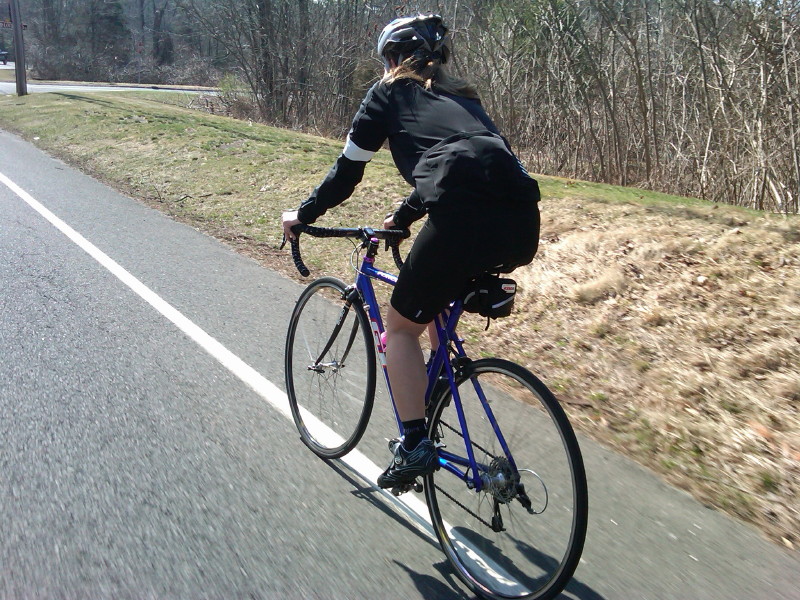
Me in Rapha, sunny day spring riding 

The gap between us and the horse started closing, and as it did a person leading the horse became visible, the thin line of a tether appeared and then the horse went into a corral and the person closed the gate.

Finally, we came to the fence behind which was this animal. The horse surged.  There was a fantastic breath of force, a few giant hoof beats on the dirt, tail flying.  It was almost as good as the dream of having it roaming free on the road–horse racing all of us on our beautiful bicycles, ballerina mindset in the midst.  Animal, machines, human beings, hearts pounding madly.

I found a video of a horse breaking out of a fence during a real bicycle race and joining the cyclists in their pursuit of the finish line. I’m sure many people have seen this video before, it must happen with some frequency, but for my dancer’s brain–a brain that is after such a convergence of athletes and beauty–I love this.  Emily Gresh

http://www.flixxy.com/horse-cycling-race.htm

The Sublime Crossing

Photo credit: steephill.tv; Reuters/Sirotti
Lieuwe Westra, Stage 5 Winner, Paris-Nice 2012; Reuters/Sirotti

Watch the finish of Lieuwe Westra in stage 5 of the Paris-Nice race and you will see the sublime crossing unfold in all of its perfection.  For all of the finishes I have seen, this is one of the purest. He looks to be victory himself proclaiming the day a good one.  There is a gesture of gratitude and pride as he wipes his hands across his chest where his team’s name is displayed. Then, even more beautifully, he opens his arms to take in all of the sweet glory that is winning.  For him, how can we not help rising to our feet?  And what a delight that he opens his arms and takes us with him.   “Hey, c’mon in, here is my win, isn’t it delicious?  Taste.”  “Ah, so good.”  We lick our lips.  We turn and lift our faces just a little,”Mmm, yes, it is really good.”  Yes, we all know that texture, that flavor on our tongue.  “This my friend,” he nods, “why, this is winning.”

Now watch the curtain open again as dancers come out to take a bow after a performance.  Watch the very best open their arms to the audience with the same purity and presence.  They know the night is theirs, that they too have won.  Do you know that as the curtain is falling, they are awaiting a bounce back open?  Like Westra, the best are in front, they feel the power of the race behind them, that they have been pushed every day by the people behind them and are better dancers for it, and that together they have all in some sense won the race.  So you see, it is not just that the curtain closes or that the cyclist gets his fraction of a second over the line that is marked finish, it is the bounce of the curtain back open, the confident letting go of the handle bars even before the race finish time has been clocked.  It is knowing that this is not one race–this win is only one amongst the many behind it and, even better, the many wins ahead.

In an X-ray somewhere far away from where I live, not so long ago were the post-crash, smashed collar bones of Swedish cyclist Emma Johansson who was recently hit by a car while training.  Johansson is one of the world’s great women cyclists at age 29.  Yet there in that X-ray, lines crossed and re-crossed the film.  Here is a break, and here another. Here, Emma, is where force decided to take the game.  Here is where your bones lost.  But Johansson is no loser and her body has a mind of its own in all games mind over matter.  These lines were only the curtain coming down where she knew there would be the bounce back up, the opened armed glory that awaits. There was victory herself, just around the corner.  Not long after those X-rays, she proclaimed the day a good one (specifically, a podium finish already on March 10, 2012).  In fact, just five days after her crash and curtain drop, she climbed on an indoor bicycle trainer and began training again.  A sublime crossing this one, a netherworld that is sweeter than winning.

If Shakespeare’s Polonius had many conniving ways about him when he said, “…unto thine ownself be true,” then there is a little of this mix of false truth and seeming earnestness in the story of the ballet dancer Sergei Polunin. Polunin recently decided to quit his profession at age 22, after years of difficult training.  His claim is that training is boring, he has conquered dance, and it’s on to tattoo parlors and whatever else for him.  He is playing a game of winner take all forever, drawing a game-over line for himself in which the game becomes a dare to not cross. The truth about Polunin, the one that we have to at least hope he will find for himself, has yet to come out.  It is one of Hamlet’s questions,  “…to be or not to be,”  not a Polonius-like cover story for a pretend face.  Yes, for Polunin…let us hope it is “to be.”

As Polunin was quitting, Westra was beautifully winning, and Johansson was getting back on her bike.  Imagine, Westra riding all that way and stopping one fraction of a second before the finish line and stating, “I am bored, training is boring.  I quit.”  In the face of win after win, there is sometimes this crunch between the race behind and the race ahead.  To let go of the handle bars just before the race is won, to climb back on the bike, to take the stage over once again, these moments carry us to the next and the next and the next.  If we are smart, if we are lucky, we keep crossing and re-crossing before it’s too late and the curtain is down for good.  Emily Gresh

http://www.steephill.tv/paris-nice/

http://www.velonation.com/News/ID/11321/Lieuwe-Westra-sours-to-take-Paris-Nice-stage-five-on-the-Montee-Jalabert.aspx

http://www.emmajohansson.com/2012/03/10/im-back/

http://www.thedailybeast.com/articles/2012/01/29/sergei-polunin-star-of-the-royal-ballet-resigns-and-no-one-knows-why.html

Shin Wrecked and Fleet Footed

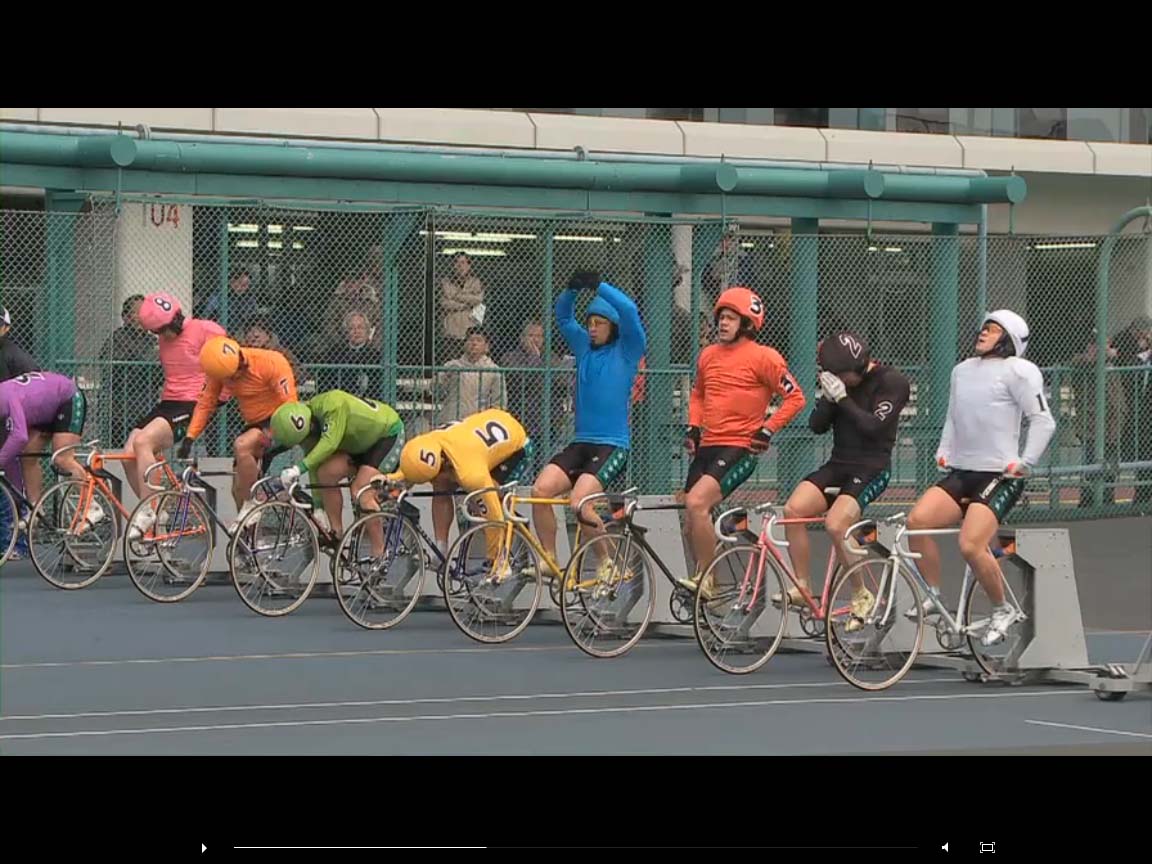
Here is a surprise: Have you seen Japanese keirin racers come out of the gates?  Have you seen them approach the starting line?  Are you unsure of the colored kits and bicycles and the gambling going on? Here is the cyclist and bicycle as horse and rider, here is 21st century Edgar Degas leaving the theater and finding the stables in a beautiful short video by Jonathan de Villiers, Inside the High-Octane and Lucrative World of Japan’s Cycling Spectacle:

Credit: Jonathan De Villiers
Japanese keirin racers at the gate.
Credit: Jonathan de Villiers

Link: http://www.nowness.com/day/2011/3/8/574

There is a backstage view in this video that is the same as a behind the wings look at ballet dancers.  Cutting back and forth between bicycle and the body we see the fine-tuning going on, face, leg, stomach, hub, wheel, fork, in the same way we would see a professional dancer’s eyes, shoulders, leg, ribbons, shoes.  An up-close and candid view of the beautiful machine shows us a calf glistening with sweat and a shin wrecked with scabs and scars.  Evidence of pushing along that line of faster, stronger, better.  Surely, in a studio not far away there is the intensity of the professional dancer who is stretching, too.  The feet, you would see, are similarly scarred beneath the pretty pink ballerina shoes, like the pink bicycle that appears in the very beginning of the video clip or the pink jersey there.  Faster, stronger, better in the ballet studio, as well.

The word velocipede is rooted in the French terms “swift” and “foot” and is the early term for the word we use today for the actual machine that is the bicycle.  With the term velocipede, the line blurs as to which is is the swift footed: dancer, cyclist, or bicycle?  In the roots of language, they are almost one and the same.  Linguistically, a pack finish.  Emily Gresh

Time’s Odometers

How far have we come?: Bicycles and dancers, endless what they say about our time, and what they free us up to do. A rider on the road passes and we do not think emancipation, we do not think image of women’s rights, we do not think oh she is relieved to be uncorsetted, or thank god for her seven pounds off her skirts. But that is what is passing by right there in front of us.  Little freedom express, little quiet joy.  You will find a similar phenomena when you go to the ballet and look at those ballet dancers and think oh poor her, ouch toe shoes, or oh this ballet is all about fairies not strong women.  Did you think not strong?  Did you think bounded?  Think again.  Consider them again.  Did you know that the one to the right of the stage left a small stifling town and traveled the world?  Did you know that the one behind her dodged a restless life she will never have to know?  And a third went to a big city and that alone changed her for life?  Beyond that, think of them now again–and I mean the real cyclists and professional dancers of our time, not the softer amateurs or the tutu-clad-but-only-nearly-there dancers–as representative of time, as occupying the forward margins of what we push for with faster and better, passionate and expressive of what our best guess is as to what aliveness might be, as to how the whole work of us might tick through the simplicity of two wheels or the slight elevation and freedom from friction offered by paper mache toe shoes.

Did you know that the first 50 bicycles manufactured in the U.S. were made in a sewing machine factory in Hartford, Connecticut?  Did you imagine the bicycle saying move over to the Singer?  This is how it was for a moment in Hartford, in a little city known for safety, known for insurance, sure enough.  Move over sewer machine thing, said the two wheeled thing.  And the women, I like think, just laughed and right there started shortening their skirts as they kissed the sewing machine good-bye.  Factually, this may not be true–I have no idea what the ratio of bike to sewing machine production is in the U.S today.  But, nice to think about…bikes taking over the sewing machine factory.  Occupy, occupy, occupy.  But dancers in the 1890’s, their skirts were already getting short, they were already finding their own little freedoms as wrapped up as they may have looked in tutus.

Think of the coincidence that around the same time that bicycles were literally taking off, Edgar Degas was sculpting The Little Fourteen-Year Old Dancer.  He was also ferociously repeating paintings and sculptures of just the body underneath the tutu, or even in the brothel.  The body at work, but at the same time, the body freed.  Away from Degas, played out over the years and on other stages, the tutu got shorter and tighter. Eventually, we got to leotard ballets, in some ways where Degas started, just the body in all of its beauty, at work and at play.  Next time you see a cyclist ride by, next time you visit the ballet, think free, and tomorrow even more.  Emily Gresh